
If you earn under £40K you’re underpaid
Analysis of salary benchmarking data for managers in data roles in nonprofits;
As a manager in a data role in a nonprofit that is.
This is part two of a several part series analysing four years of data vacancy data in nonprofits. Part one gives an overview and explains a bit more about the dataset.
Managers
Let's look at the Manager job family.
This family includes quite a diverse set of roles. Broadly if it looks to me like it has some level of seniority but isn’t a “senior analyst” or if it looks like it involves line management but isn’t a head-of or director role I stick it in here.
How much managers get paid
Manager roles had median salaries of £45,700 in 2026. Up from £42,000 in 2022.

Let's look at the spread of advertised salaries. Here's the spread between lower quartile and upper quartile.

If your salary is between the dots then you're in the same range as 50% of managers. If your salary is lower than the lower dot you're in the range where only 25% of managers get paid this little. If your salary is higher than the high dot, you're in the range where only 25% of managers get paid this much.
Or to put it another way. If your role is in this manager family and you earn under £40K you’re not well paid. Whereas if your salary is about £52,000 you are doing very well. Though it’s worth bearing in mind that these roles include London weighting where that is relevant so if you are based outside London you might want to knock a few thousand quid off that benchmark.
I find it really helpful to look at the spread of all salaries. These charts have a dot for each vacancy. I’ve annotated a few so you can see what sort of roles we’re talking about here.
I’ve drawn one chart for each calendar year. There’s some evidence of wage inflation in this dataset so bear that in mind as you go back in time.
2026

2025
2024

2023

2022

Working styles
The majority of Manager roles are hybrid positions. On-site positions are the next common but 19% of roles are Remote (this includes roles where Remote is an option). That's pretty much the same split as data jobs overall.

What can you do with this?
If you work in a data role that might be considered a manager in a data role in a nonprofit I hope this will give you a sense of how your salary compares to the benchmark. If you have an HR or executive role in a non-profit then hopefully this will help you think about the costs of recruitment and retention.
The other thing I have always hoped this newsletter will achieve is demonstrate to data professionals outside the nonprofit sector that there are viable, interesting (and socially impactful) roles in nonprofits. But this might also give you a reality check about the financial rewards of moving into the sector.

(Nearly) all the data jobs are in London
An overview of pay, working style and location of data job adverts in nonprofits
Four years of newsletters
Back in June 2022 I started collecting links to data vacancies in non profits. I wanted to show people that there are data roles in nonprofits and help anyone interested in the sector get a handle on what is going on.
I publish these links in a short email to subscribers roughly weekly. You can subscribe here.
Data jobs
What's a data job?
It's whatever I decide it is.
I don't spend a lot of time worrying about whether to include a job or not. To some extent I include jobs that I could see myself applying for or having applied for. I am looking for jobs that are working directly with quantitative data (or managing those who work directly with the data)
It's a curated and personal list. I almost never include vacancies in universities. I often do include vacancies in national galleries. I don't include MEL vacancies unless they are also what I regard as data jobs.
This constitutes quite an interesting dataset and over the next few weeks I'll be exploring some aspects of the data.
Insights
Fresh analysis
With my colleagues at Data Orchard CIC I have published a couple of analyses in the past. Like this in 2024 and this in 2025.
For this series I've started with a fresh look at the full dataset. There are a number of judgements I've made in preparing the data which may differ to those previous analyses. So there may be apparent disagreements between them.
Adverts
As of the end of July 2026 I had listed 2,192 unique vacancies (based on my judgement of what constitutes the same advert that I accidentally included twice) from 1,095 unique organisations. I have manually classified each vacancy into one of a series of job families.

As you can see the dataset is heavily skewed. The most popular job types are Manager, Analyst and Officer. There are also enough vacancies for Head, Senior Analyst and Admin to make for some interesting analysis.
I'll be focusing on each of those in turn over coming weeks.
Salaries
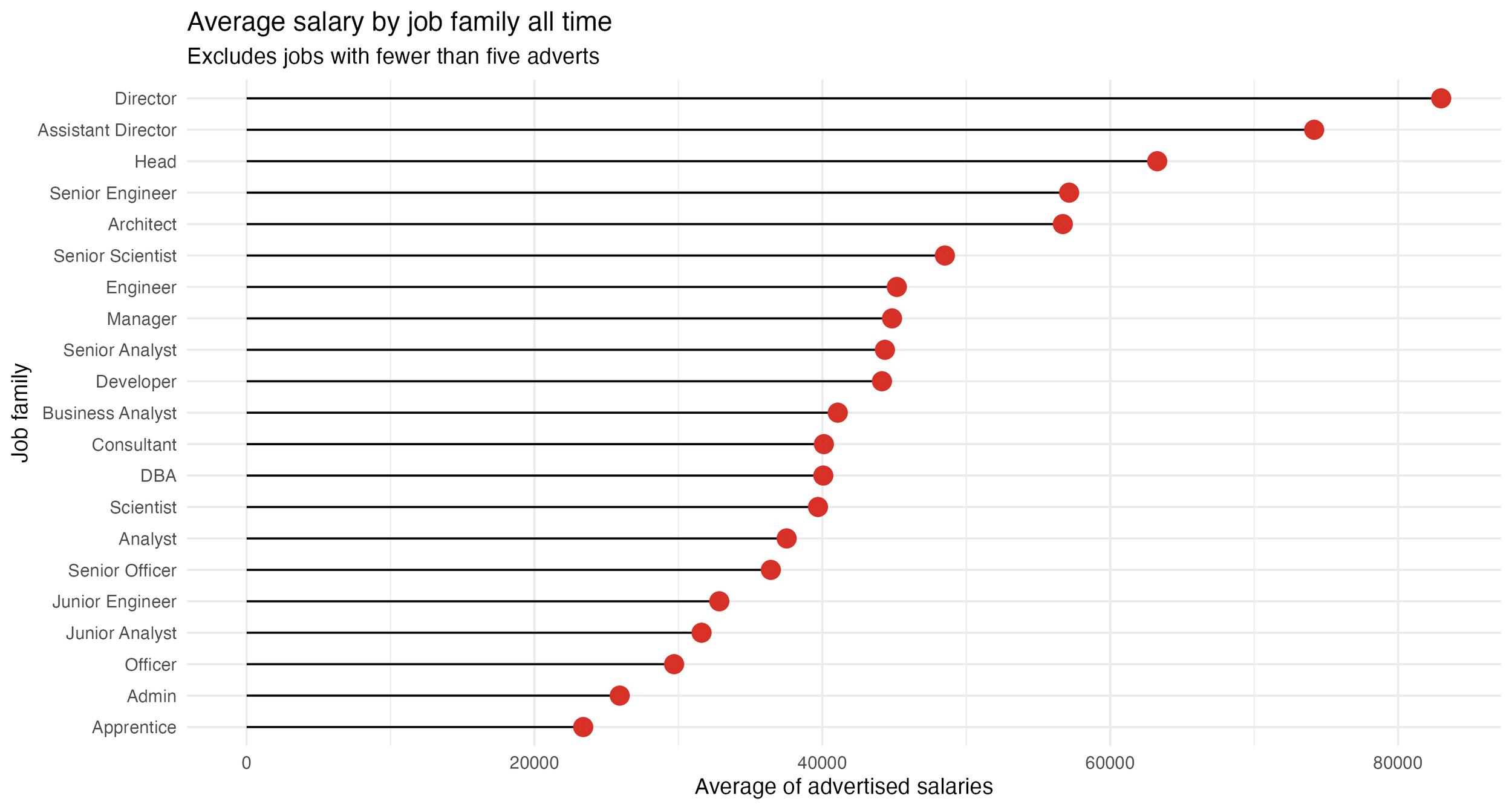
This really is very broad brush. But fun.
We probably expect that there was wage inflation over the past few years (I'll explore that in more detail for each job family in future weeks). So what you really want to know is what do people get paid right now.
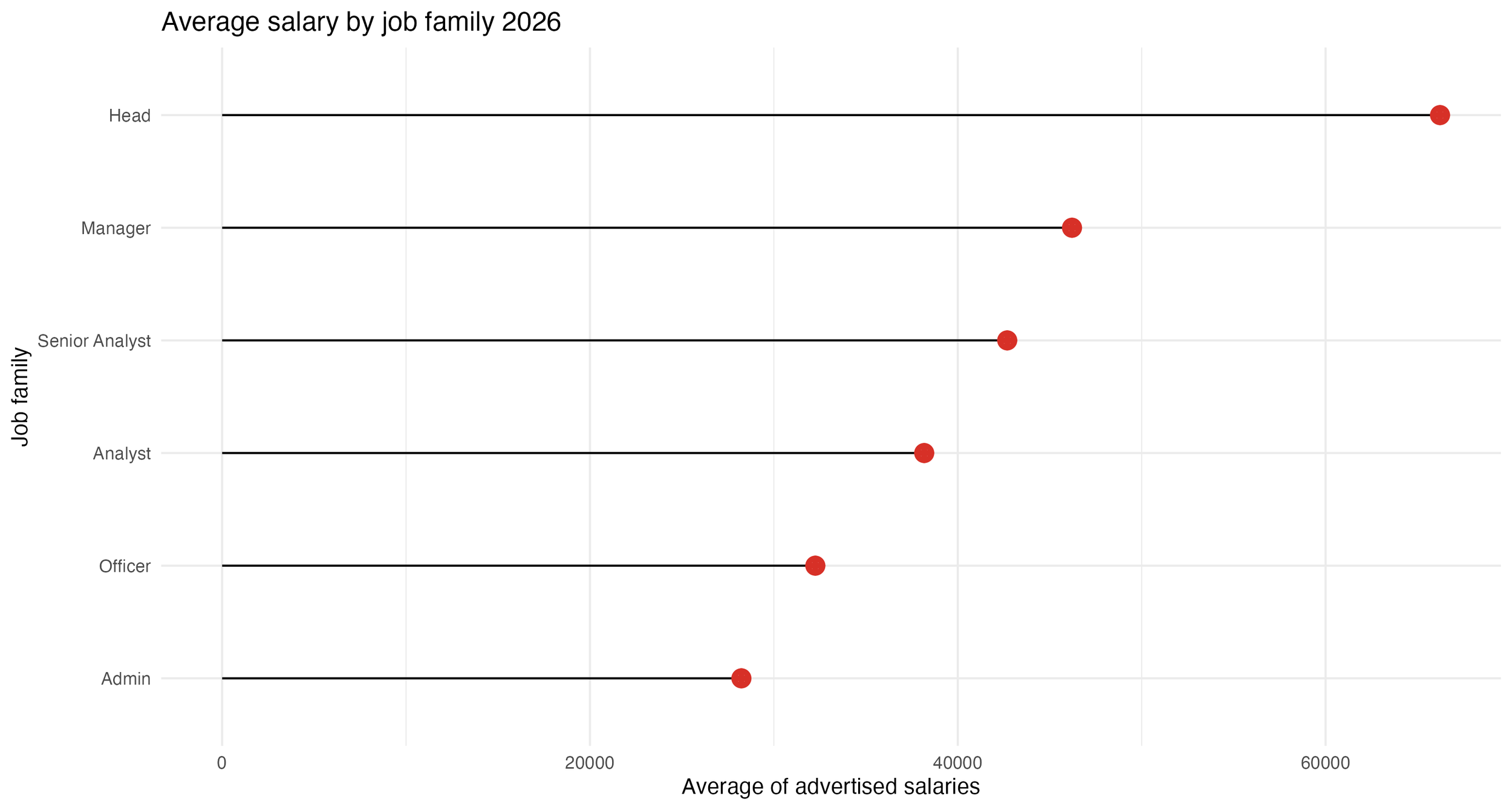
Here's the data for the key job families (i.e. job familiesI have plenty of adverts for) just for 2026 (so, in fact, the first seven months of 2026).
Working style
One thing I'm very interested in is whether jobs are on-site, hybrid or remote. For simplicity, if a job is advertised with a range of styles I'll mark it as Remote if that's an option and Hybrid if Remote is not an option. I only use "Flexible" if that's what the advert says and I can't quickly discern what they mean in my terms.
Overall this is what the market looks like.
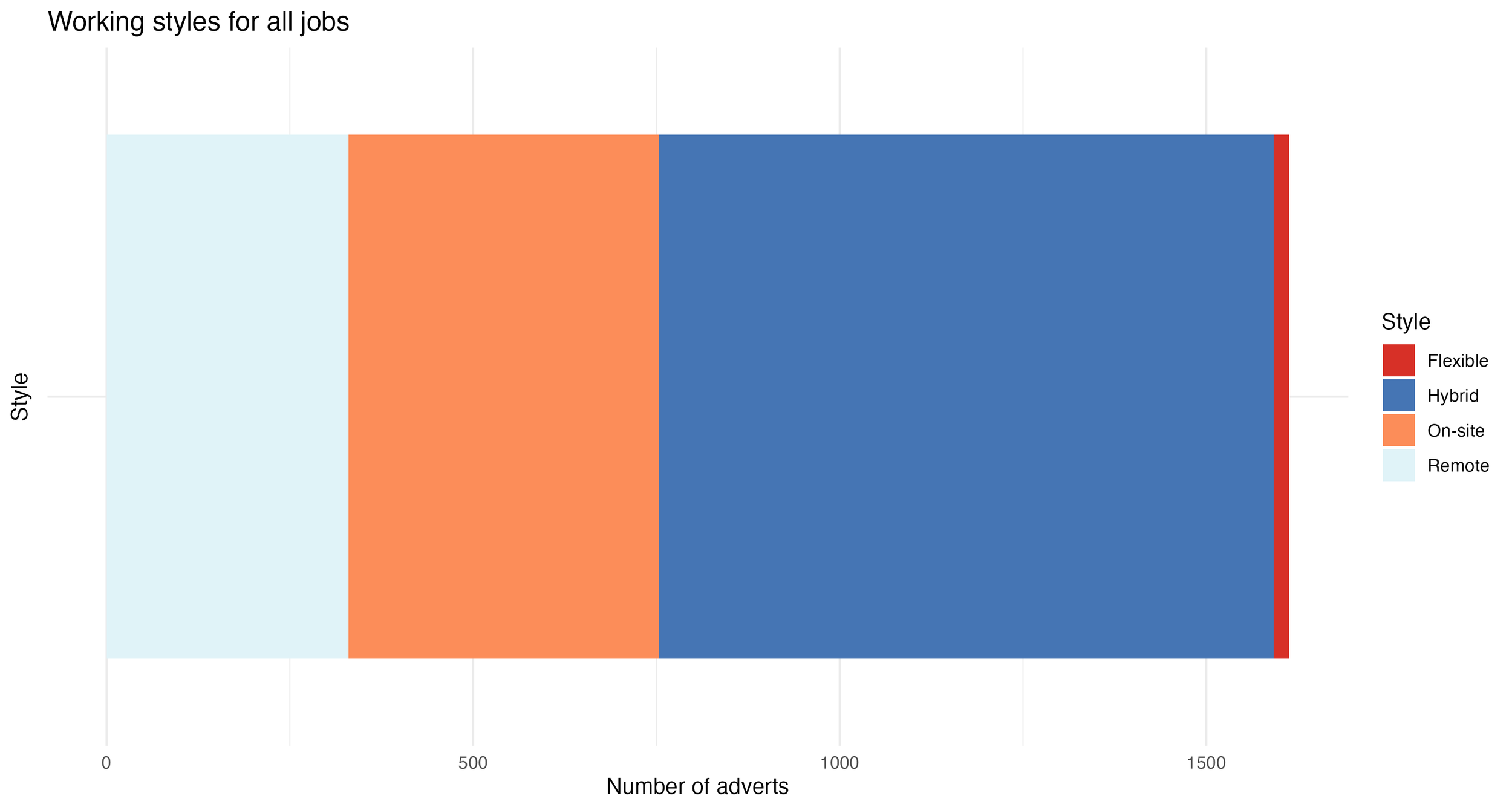
About half of all jobs (52%) are hybrid with the remainder split between remote (20%) and on-site (26%) work. Something to consider if you're advertising a new vacancy.
Location
Where jobs have a location given (for Hybrid or On-Site roles) I have generalised the location into the nations and regions of the UK.
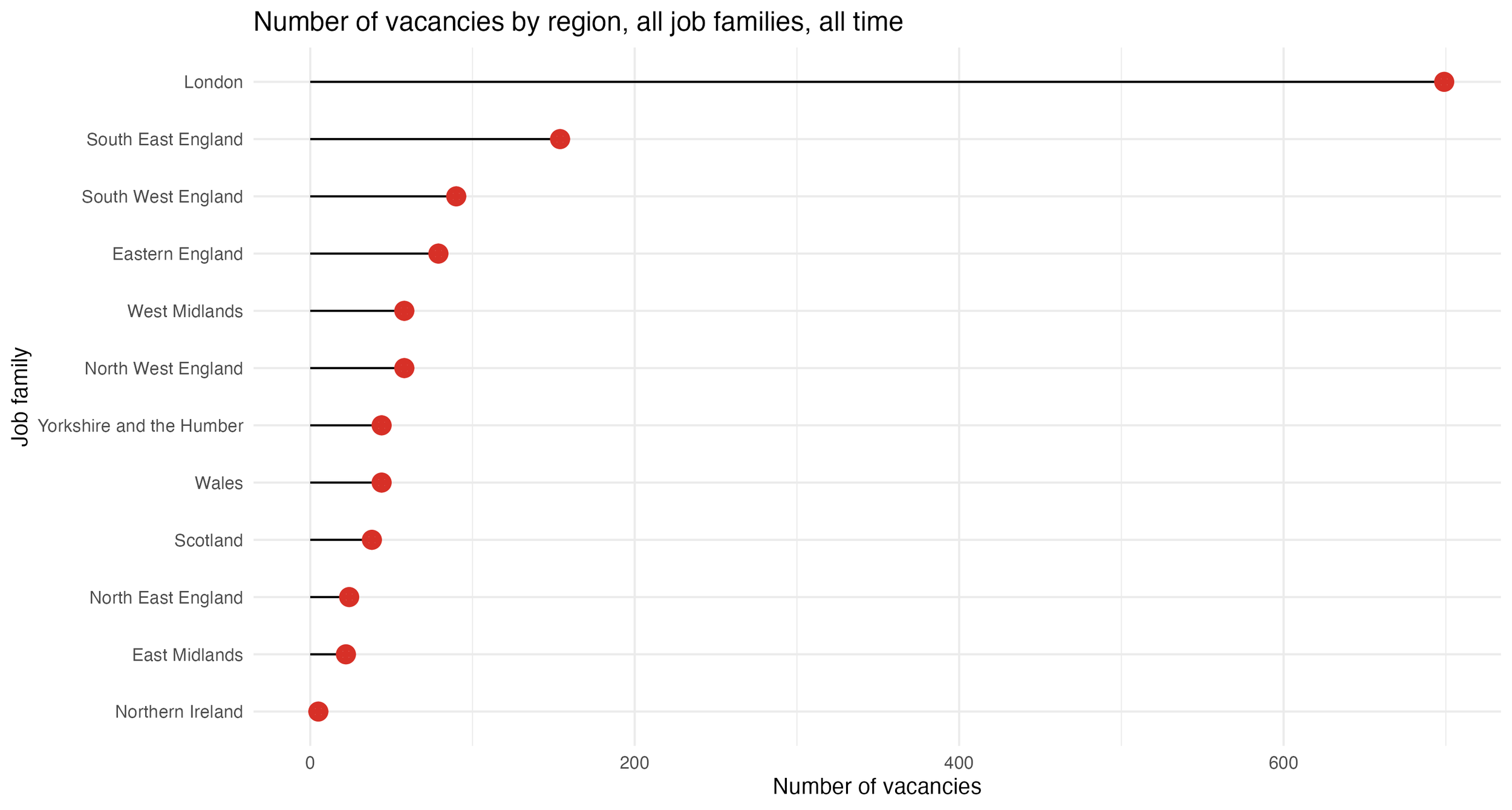
London dominates.
It might be that this dataset is biased by the sources I use to find vacancies. I suspect that Northern Ireland vacancies are more likely to appear in island-of-Ireland media rather than the UK-centric media I'm looking in for example. It might be that organisations based outside London are more likely to allow Remote working as a recruitment incentive. It might just reflect the dominance of London in our economy.
What's next
Over coming weeks I'll have deeper dive into the Manager, Analyst, Officer, Head, Senior Analyst and Admin job families in turn.
Drop me a line with questions or suggestions for analysis.
Hire me
I'm freelance. If you need any help with research or analysis in your organisation. Drop me a line.
If you appreciate the work I do with this newsletter why not Buy me a coffee?
Interesting links weekending 2025-06-08
Interesting links I’ve found
For my reference really but you’re welcome to share
Developing community power standards with Manchester City Council - Interesting and probably standards are helpful but I’d like to see more on the impact
Talking of outcomes TPXImpact re-upped this post from GDS about service outcomes always worth refering to
Talking of outcomes (again) they feature large in Nesta’s test and learn playbook disappointingly this is addressed to UK gov so it may not be too much use in the foothills of localgov
Talking of Test and Learn, nod along to James Plunkett’s Neighbourhoods as engines of change
Principles for services organisations (sort of a maturity assessment) is worth a bookmark
A gonorrhoea vaccine will soon be available in the UK - vaccines are cool
I went to an LGA webinar on financial inclusion and came away with some interesting links including:
A case study of the financial benefits of a credit union’s homeless prevention scheme
Can local No Interest Loan Schemes help low-income households to weather financial bumps in the road? A case study from County Durham
Can we make it safe for kids to play in the streets?
With the exception of London, deprived settlements in England tend to have fewer, smaller and further-away playgrounds. Really interesting. I wonder how this maps onto rural areas where many children may live very far from playgrounds.
This is interesting and I’m going to have to think about it some more to understand it Visualizing as a Form of Collective Care
Another card game for dataviz training (not saying that’s a bad thing)
A webinar on Using Connected Vehicle Data to Gain Enhanced Insights into Road Network Performance <- Interesting though I’m not sure that data is the constraint so much as money to fix potholes on the network